By Ashley Newell · June 25, 2026
Hard Water in Adelaide and the Murraylands: What It Does to Your Plumbing (and How to Protect It)
If you have ever wiped a chalky white film off a shower screen, watched a kettle fur up, or replaced a hot water system sooner than you expected, you have met hard water. Across metropolitan Adelaide and out through the Murraylands, our tap water carries a decent load of dissolved minerals, and over the years that quietly costs homeowners money in shortened appliance life and higher energy bills. Here is why our water runs hard, what it does to your plumbing, and the practical steps that protect it.
Why Adelaide and Murraylands water runs hard
Hardness comes from dissolved calcium and magnesium, and where your water is sourced makes all the difference. Adelaide leans heavily on the River Murray, in dry years for up to around 90% of supply. By the time that water has travelled hundreds of kilometres, it has picked up far more mineral content than the water in cities that collect close to their source. SA Water reports metropolitan hardness commonly in the range of roughly 90 to 140 mg/L as calcium carbonate depending on your supply zone, which sits in the moderate to moderately-hard band. Communities along the river plains, from Murray Bridge through to Tailem Bend, often notice it even more, because they are drawing water even closer to that mineral-rich source.
To be clear, this water is safe to drink and stays within the Australian Drinking Water Guidelines. Hard water is a nuisance and a maintenance issue, not a health scare.
What scale does inside your plumbing
When hard water is heated or left to evaporate, those dissolved minerals drop out and set as scale, a hard, chalky crust. It builds up exactly where you do not want it:
- Hot water systems. Scale coats heating elements and lines the bottom of the tank, acting like insulation. The system has to work harder and burn more energy to heat the same water, and even a thin layer can lift running costs noticeably.
- Taps, mixers and valves. Scale narrows internal passages, roughens moving parts and makes tap washers and cartridges fail sooner.
- Showerheads. Blocked nozzles are the classic sign, giving you a weak, sideways spray.
- Appliances. Dishwashers, washing machines and kettles all scale up internally, losing efficiency over time.
Signs your home has a hard-water problem
- White, chalky residue on taps, glassware and shower screens
- Showerheads and aerators that clog or spray unevenly
- Soap and detergent that will not lather well, and spotty dishes
- A hot water system that is noisier, slower to recover or costing more to run
- Dry, filmy feeling on skin and hair after showering
- More frequent tap, cartridge and washer repairs than you would expect
n
How hard water shortens appliance life
Scale is relentless. Left unchecked, it forces water heaters and appliances to run hotter and harder, and components exposed to constant mineral build-up can wear out substantially faster than they would on soft water. That means the hot water system you hoped would last a decade may need replacing years early, and the same goes for dishwashers and washing machines. The cost is not just the replacement; it is the extra energy every one of those scaled-up appliances burns in the meantime, plus the water and detergent wasted when things stop working efficiently. Catching scale early, before it damages a heating element or seizes a valve, is almost always cheaper than dealing with the failure it causes.
The soft-water contrast up in the Hills
It is worth noting the flip side. Many Adelaide Hills homes run on rainwater collected from the roof, which is naturally soft, low in dissolved minerals and much kinder to hot water systems and fittings. Soft rainwater brings its own considerations, such as being slightly acidic and needing clean tanks and good filtration, but scale is rarely the problem. If you have moved from a rainwater block in the Hills to a mains-fed home on the plains, that chalky build-up you are suddenly seeing is the difference between soft and hard water.
How to protect your plumbing from hard water
You cannot change the source, but you can manage the effect:
- Maintain your hot water system. Regular servicing, flushing sediment from the tank and replacing a spent sacrificial anode on schedule all fight scale and extend the unit’s life. Do not wait for it to fail.
- Descale fittings. Soaking showerheads and aerators in a vinegar solution clears mineral build-up and restores flow. Worn tap washers and cartridges should be replaced rather than forced.
- Consider a water softener or conditioner. A whole-of-home softener uses ion exchange to swap the hardness minerals out before they reach your pipes and appliances, cutting scale at the source. It is the most thorough fix for a genuinely hard supply.
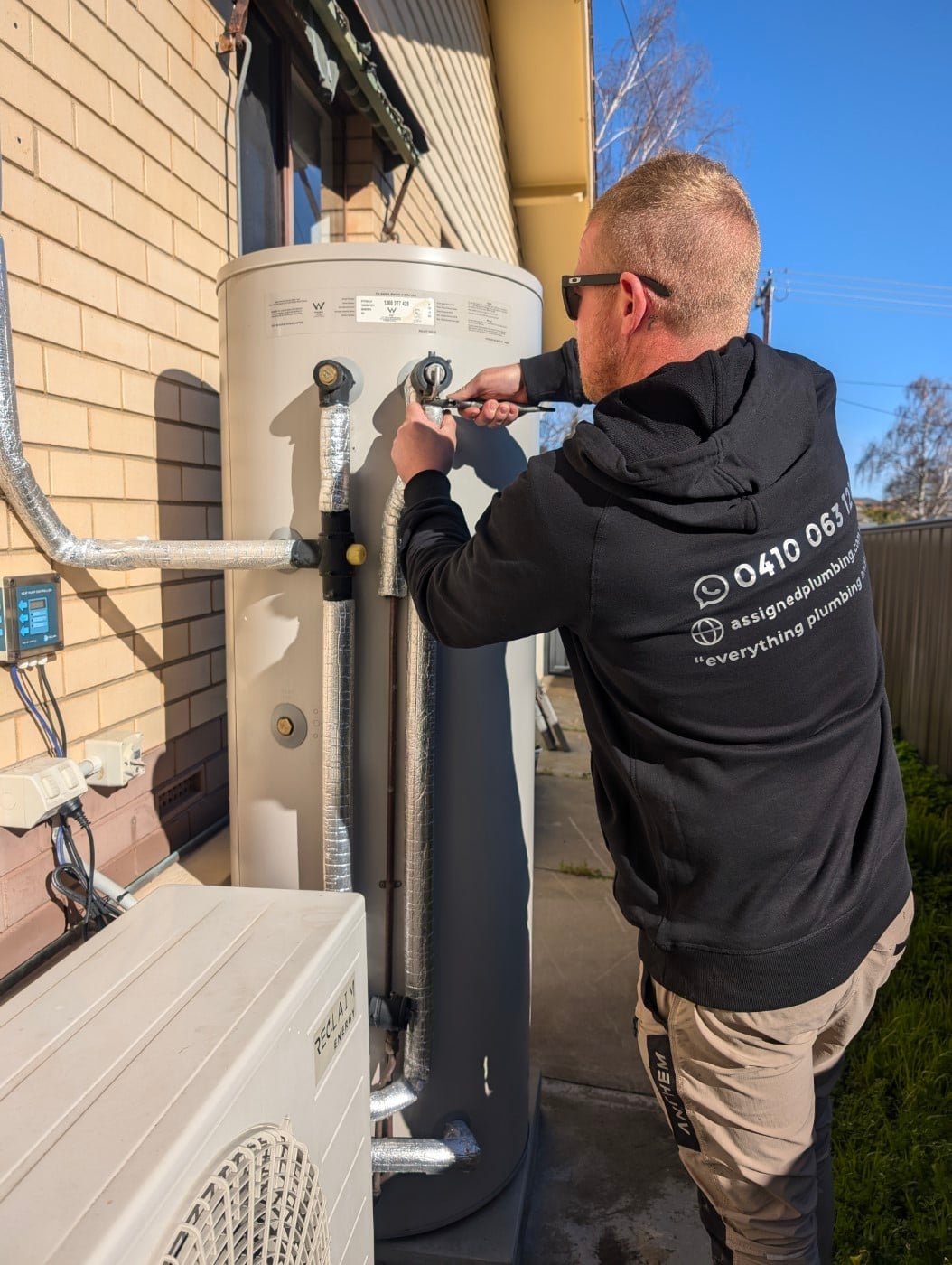
- Choose the right hot water system. When it is time to replace, the type and quality of unit, and how it copes with local water, matters. Our hot water systems service can help you pick and install a system suited to your area and set it up to last.
For homes out on the river plains, having a local plumber who understands the water is a real advantage. Our team works throughout the region, including Murray Bridge, and we see first-hand what the local supply does to hot water systems and fittings.
Talk to a local plumber about your water
Assigned Plumbing Services is a family-owned, fully licensed plumbing and gas business serving Adelaide, the Adelaide Hills and the Murraylands. If hard water is scaling up your hot water system, clogging your fittings or driving up your bills, call us on 0410 063 121 and we will help you protect your plumbing for the long run.
Free, no obligation
Got a plumbing job in mind?
From a leaking tap to a complete restoration, Assigned Plumbing covers Adelaide and all surrounding areas with over a decade in the trade. Call Ash today for a free, no-obligation quote.